Showing posts with label Math Trivias. Show all posts
PYTHAGOREAN THEOREM EXPLORATION 2 (CUT-OUTS)
 |
| Pythagorean Theorem Exploration 2 Cutouts |
You may download this template for personal use and for your math class activity. The length of the sides on the second page measures 6.5 inches. This is also the measure of the length of the hypotenuse of the right triangle on the first page.

Your comments and suggestions are welcome here. Write them in the comment box below.
Don't forget to like and share.... :)
Thank you and God bless!
Don't forget to like and share.... :)
Thank you and God bless!
PYTHAGOREAN THEOREM (Exploration 2)
 |
| The Pythagorean Theorem |
Start with a cutout of a right triangle.

Cut three more cutouts.

Let us name the sides of the right triangle with c as the hypotenuse.

Now, let us form a square using the four (4) triangles. This time, use the hypotenuse as the sides of the square.


Let us take a look at the different parts of the square we formed. If we separate the whole square, we can get its area in terms of c.

The middle part is also a square with sides equal to the difference of sides b and a. The area can be obtained as

On the other hand, the area of the four triangles outlining the sides of the whole square is as follows.

Combining their areas, we obtain

Thus, c^2 = a^2 + b^2.
Your questions, comments and suggestions are welcome here. Kindly write them in the comment box below.
PYTHAGOREAN THEOREM (Exploration 1)
 |
| The Pythagoras' Theorem |
The theorem states that the square of the length of the hypotenuse is equal to the sum of the squares of the lengths of the remaining sides. That is c^2 = a^2 + b^2, where c is the hypotenuse, a and b are the lengths of the remaining sides.
Here is one of the theorem. Take note that the theorem only applies to right triangles.
Start with a cutout of any right triangle.





Hope this will help you understand the derivation of the Pythagoras' Theorem.
Your comments and suggestions are welcome here. You may write them in the comment box below. Thank you!
EXTERIOR ANGLE THEOREM (Part 2: Proof)

Your comments and suggestions are welcome here. You may write them in the comment box below.
THE SUM OF THE ANGLES OF A TRIANGLE (Part 1: Exploration)

Everybody knows that the sum of the measures of the angles of any triangle is 180 degrees. If I may ask each one of you why, one of the reasons that I may probably hear is that "Our math teacher told us!" - which should not be the case. You should know how to show that the sum of the angles of any triangle is really 180 degrees. Where do 180 degrees come from? Why 180 degrees? Why not 360 degrees?
The purpose of this post is to show you how to prove that the sum of the angles of any triangle is really 180 degrees. This is the first method, which is the elementary way - the easiest way, to prove it. The other methods will also be posted here.
PROVE: The sum of the measures of the angles of any triangle is 180 degrees.
PRE-REQUISITE: The sum of the measures of the angles that form a straight line is 180 degrees.
MATERIALS NEEDED: colored papers or cardboards, pair of scissors, ruler, marker
PROCEDURES:
1. Cut three different types of triangles, classified according to angles. Use the colored papers or cardboards for the triangles. One should be a right triangle, another should be an acute triangle and the last should be an obtuse triangle.


2. For us to easily identify the angles of the triangles later, highlight the edges of each triangle using a black (or any dark colored) marker.


CONCLUSION: The sum of the measures of the angles of any triangle is 180 degrees.
For educators and parents, I have made a worksheet for this activity for your class/children. You are free to download and print it. You may group your students and let each group work on a triangle or all the triangles. I hope this will be helpful.

1 = 2?

Maybe you are wondering why or how can 1 be equal to 2. Let us look at the following proof:
First, let us have two real numbers a and b where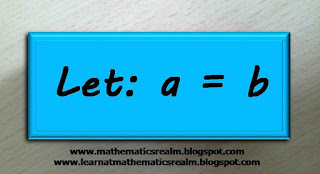

Using the addition property of equality, let us add b on both sides.

If we simplify both sides by combining like terms, it will become

Now let us subtract 2a on both sides
 Combining like terms, we will arrive at
The right side has a common factor, which is 2. Using distributive property, it can be rewritten as

If you notice, both sides has a common factor, which is b - a. To simplify the equation, let us divide both sides by the common factor.


The process will arrive at

Are you convinced? No no no...
Seems like the proof is valid but there is something wrong with it. Look over the proof once again. Can you identify which of the process is not valid?
There is nothing wrong with the given. Real numbers can be equal. There is nothing wrong also with adding b and subtracting 2a on both sides. Likewise, there is nothing wrong with combining like terms on both sides. Then, where is the mistake?
There is nothing wrong with dividing both sides by any number but in this case it becomes invalid. The reason is that b - a = 0 since a = b. Subtracting equal numbers will yield 0. Since b - a = 0, then the result will be UNDEFINED. We cannot also cancel out b - a on both sides because of that.
Therefore, 1 is not equal to 2.
Here is a copy of the proof in pdf form. You may download and print it for educational purposes. You may share it to your friends. Your comments and suggestions are also welcome here.