Showing posts with label Math Trivias. Show all posts
PYTHAGOREAN THEOREM EXPLORATION 2 (CUT-OUTS)
 |
| Pythagorean Theorem Exploration 2 Cutouts |
You may download this template for personal use and for your math class activity. The length of the sides on the second page measures 6.5 inches. This is also the measure of the length of the hypotenuse of the right triangle on the first page.

Your comments and suggestions are welcome here. Write them in the comment box below.
Don't forget to like and share.... :)
Thank you and God bless!
Don't forget to like and share.... :)
Thank you and God bless!
PYTHAGOREAN THEOREM (Exploration 2)
 |
| The Pythagorean Theorem |
Start with a cutout of a right triangle.

Cut three more cutouts.

Let us name the sides of the right triangle with c as the hypotenuse.

Now, let us form a square using the four (4) triangles. This time, use the hypotenuse as the sides of the square.


Let us take a look at the different parts of the square we formed. If we separate the whole square, we can get its area in terms of c.

The middle part is also a square with sides equal to the difference of sides b and a. The area can be obtained as

On the other hand, the area of the four triangles outlining the sides of the whole square is as follows.

Combining their areas, we obtain

Thus, c^2 = a^2 + b^2.
Your questions, comments and suggestions are welcome here. Kindly write them in the comment box below.
PYTHAGOREAN THEOREM (Exploration 1)
 |
| The Pythagoras' Theorem |
The theorem states that the square of the length of the hypotenuse is equal to the sum of the squares of the lengths of the remaining sides. That is c^2 = a^2 + b^2, where c is the hypotenuse, a and b are the lengths of the remaining sides.
Here is one of the theorem. Take note that the theorem only applies to right triangles.
Start with a cutout of any right triangle.


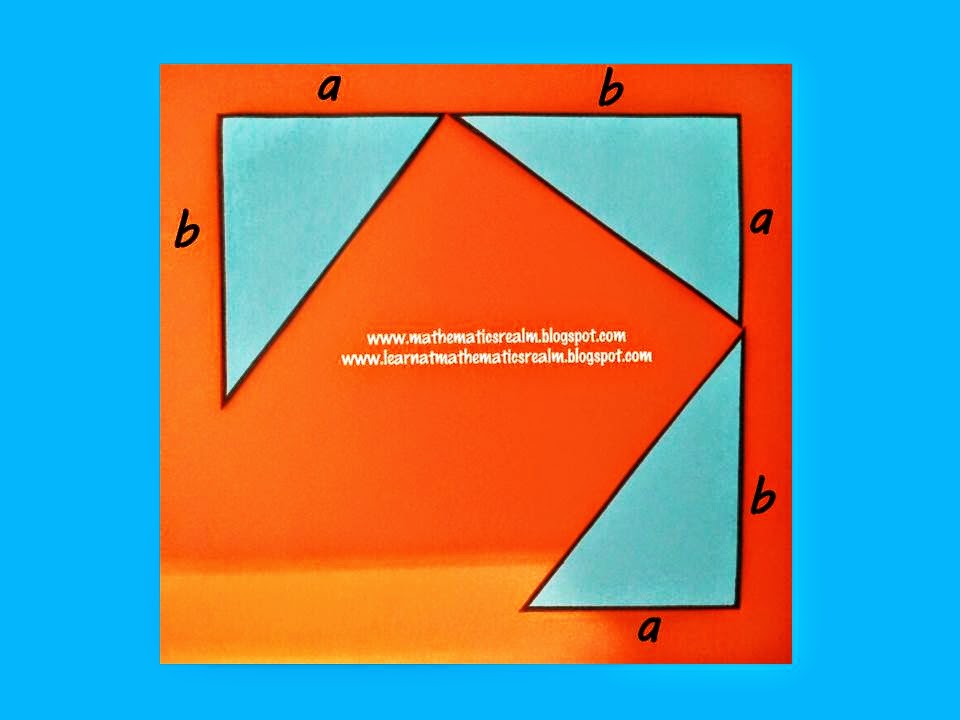


Hope this will help you understand the derivation of the Pythagoras' Theorem.
Your comments and suggestions are welcome here. You may write them in the comment box below. Thank you!


